Most people quit a habit after a week because they start too big, rely on motivation, and treat one missed day as the end. The research points the other way: start with something small, tie it to a cue, and expect a miss. Below: what the studies found, and five changes to try. The five changes are my advice, built from that research.
Why does the first week feel easy and the second hard?
Motivation is highest at the start. Then the novelty fades and the habit has to run on something else. That is my reading, not a finding from a study. What the studies do show is how long the other route takes. In Lally and colleagues’ study, new daily habits took 66 days on average to reach their peak automaticity, and individual times ranged from 18 to 254 days (BPS Research Digest, 6-Oct-10). Lally herself says the length of habit formation “is highly variable” (University of Surrey, 21-Jan-26). So a week in, you are nowhere near done. Our post on how long it takes to form a habit has the details.
Does one missed day ruin a habit?
No. The BPS summary says “a single missed day had little impact on later automaticity gains.” A paper for GPs by Gardner, Lally and Wardle says that missing the occasional opportunity “did not seriously impair the habit formation process” (British Journal of General Practice, Dec 2012). The BPS summary adds a warning: missing many repetitions, even spread over time, appears to lower the level of automaticity people reach in the end. So a miss is fine. Dropping the habit for weeks is the real risk.
Are small habits easier to keep?
The same GP paper says automaticity peaked more quickly for simple actions, with drinking water as its example, than for more elaborate routines such as 50 sit-ups. The BPS summary reports that more complex behaviours took longer, and exercise habits took about one and a half times as long as eating or drinking ones. These were habits that people chose themselves, in a small student group, so treat the numbers as a guide.
The GP paper also includes a one-page habit plan for patients. It boils down to this: pick one simple daily action, tie it to the same time and place each day, do it every time that moment comes round, and keep a tick-sheet so you can see your progress. The handout says that “within 10 weeks you should find you are doing it automatically.” Ten weeks, not one.
What are five changes to try?
- Shrink the habit. If you planned 30 minutes, plan two. The aim of the first weeks is to repeat the action, not to do it well.
- Pick a cue you already have. The GP paper advises repeating the behaviour in the same context until it becomes automatic. After brushing your teeth, after the coffee, after you sit down at your desk.
- Write the plan down. Lally says a clear plan of when and where makes you more likely to act than a vague intention. “After I pour my coffee, I write one line.”
- Decide in advance what a miss means. A rule I suggest: one miss is nothing, but try not to miss twice in a row. That rule is my advice, not a research finding.
- Make it visible. A calendar with an X for each day shows progress. For why feedback loops help, see that post.
What if you have already stopped?
Neither the GP paper nor Lally’s own account gives a method for restarting after a long break, so this part is my advice. Restart with the smallest version of the habit, in the same place and at the same cue as before. The GP paper warns that varying the behaviour or the setting is “incompatible with development of automaticity”, and that gains soon resumed after a single missed performance. It is the long gap that costs you. Lally also says that “knowledge alone does not lead to behaviour change” (University of Surrey, 21-Jan-26). So reading about habits is not enough. Write down when and where you will do it, and do it tomorrow.
What next?
If your habit is a phone one, start with How Do I Stop Doomscrolling?. To see which habits you already have, read What’s the Big Deal With Habits?. If you think the answer is more discipline, discipline or motivation looks at what to rely on instead.
Want more?
Habit Ignition: 41 Steps to Unlocking the Secret Power of Habits and Rituals for Life

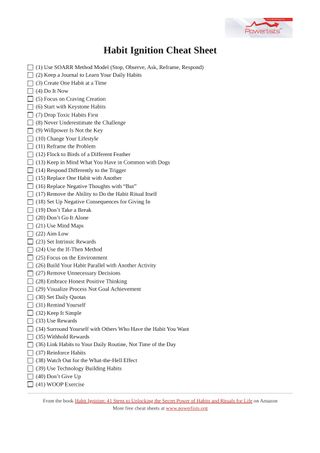
Get the free Habit Ignition cheat sheet
Frequently asked questions
Why do I quit a habit after a week?
Most people start too big, rely on motivation, and treat one missed day as the end. The research points the other way: start small, tie it to a cue, and expect a miss.
Does one missed day ruin a habit?
No. The study summary says a single missed day had little impact on later automaticity gains, though missing many repetitions appears to lower it.
Are small habits easier to keep?
Yes. Automaticity peaked more quickly for simple actions such as drinking water than for more elaborate routines such as 50 sit-ups.
How long does a habit take to stick?
In the Lally study, new daily habits took 66 days on average, with individual times from 18 to 254 days. The GP handout says to expect about 10 weeks, not one.
What if I have already stopped for weeks?
The sources do not give a restart method. A single miss did little harm, but many missed repetitions appear to lower the level of automaticity you reach. My advice is to restart with a very small version, at the same cue and place.