Motivation is a feeling, and feelings come and go. Discipline is what you have when the feeling is missing. If you are starting from zero, the best evidence points away from gritting your teeth harder and toward a smaller start, a clear cue and a plan. Below: what the research says about willpower (it is mixed), what it says about habits, and five steps to try. The five steps are my advice, built on that research.
Is discipline just willpower?
For years the popular idea was that willpower is like a muscle or a fuel tank. Use it on one task and you have less for the next. This is called ego depletion. The idea has not held up well. A preregistered test across 36 labs with 3,531 people found a result close to zero: the main test gave d = 0.06, which is not statistically significant, and the authors wrote that “preregistered analyses did not find evidence for a depletion effect” (Psychological Science, October 2021).
A 2023 replication of a well-known study, with 187 people, also failed to find the effect. Its introduction says the last several years have brought “major challenges to the ego-depletion effect.” The same introduction notes that an early analysis found a moderate effect, while later ones suggest the true effect may be much smaller or absent, partly because of publication bias (PLoS ONE, 29-Jun-23).
So the research is mixed, and the fair summary is this: the “tank runs dry” story is not well supported. That does not mean self-control is easy. It means the answer is probably not to save your willpower for later.
Why does motivation not last?
I can only give my reading here. Motivation is highest when an idea is new. Then the novelty fades, and whatever you built has to run on something else. That something else is a habit. Habits are behaviours “triggered by a cue in the environment rather than by conscious will,” as the BPS Research Digest put it when it covered Lally’s study (BPS Research Digest, 6-Oct-10).
In that study, 96 students signed up to repeat a new behaviour once a day for 84 days and rate how automatic it felt. Eighty-two finished. The average time to reach peak automaticity was 66 days, with a range of 18 to a predicted 254 days. Roughly half had not reached habit status by day 84. Early repetitions gave the biggest gains. A single missed day had little effect, while many missed days lowered the level people reached. The researchers relied on self-reports, which they accept is a weakness.
What does a plan add?
Dr Pippa Lally says that if you make a clear plan of when and where you will do something, you are more likely to do it than if you only have a vague intention (University of Surrey, 21-Jan-26). A 2025 analysis of 642 tests of this kind of planning, “if situation X, then I do Y”, found positive effects across thinking, feelings and behaviour. Effects were larger when the plan had the if-then format, when people were highly motivated, and when the plan was rehearsed (European Review of Social Psychology, 2025). Note that last part: plans work better when you care about the goal. A plan does not replace caring.
What are five steps to build discipline from zero?
These are my advice. The research above does not test them as a set.
- Pick one action. Not a new life. One thing you can do in two minutes.
- Tie it to a cue you already have. “After I pour my morning coffee, I write one line.” Say it out loud once or twice.
- Make the start so small you cannot argue. If you planned 30 minutes, plan two. You can always do more.
- Decide what a miss means. One miss is nothing. Try not to miss twice in a row.
- Count days, not feelings. Tick a calendar. On a flat day, the tick is the win.
If you slip for a week, restart at step one. Starting again is part of the process, not proof you lack discipline.
What next?
For why habits fade after the first week, read Why Do I Start Strong and Quit After a Week?. For the basics of how habits work, see What’s the Big Deal With Habits?. If you keep putting a task off, see How Do I Actually Stop Procrastinating?.
Want more?
Habit Ignition: 41 Steps to Unlocking the Secret Power of Habits and Rituals for Life

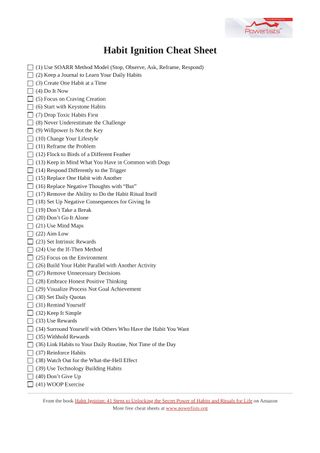
Get the free Habit Ignition cheat sheet
Frequently asked questions
Is discipline just willpower?
Not in the tank-runs-dry sense. A preregistered test across 36 labs with 3,531 people found no evidence of an ego-depletion effect, so that story is not well supported.
Why does motivation not last?
Motivation is highest when an idea is new. Once the novelty fades, what you built has to run on a habit, which is triggered by a cue in the environment rather than by conscious will.
How do I build discipline from zero?
Pick one action, tie it to a cue you already have, make the start so small you cannot argue, decide what a miss means, and count days, not feelings. These steps are my advice.
How long does it take to build a habit?
In Lally's study the average time to peak automaticity was 66 days, with a range of 18 to a predicted 254 days.