A new habit took 66 days on average to feel automatic in the best-known study of the question, but the range ran from 18 days to a projected 254. There is no fixed number. How long yours takes depends on you and on how hard the habit is. Below: what the study found, why the numbers vary, and five steps to start.
What did the research find?
Phillippa Lally and colleagues at University College London recruited 96 students and asked each to choose a new health-related behaviour and repeat it once a day for 84 days. Eighty-two finished. The average time to reach maximum automaticity was 66 days. Individual times varied “from 18 days to a predicted 254 days” (British Psychological Society summary, 6-Oct-10). The full paper is Lally and others, How are habits formed: Modelling habit formation in the real world, European Journal of Social Psychology, 2010.
Each person picked their own habit, such as a 15-minute run before dinner, a piece of fruit with lunch or 50 sit-ups after morning coffee, and tied it to a daily cue. They logged in each day to say whether they had done it, and rated statements like “I do it without thinking”. Early repetitions brought the biggest gains in automaticity. After that the gains shrank until they levelled off.
Two cautions. The 254-day figure is a projection, since the study ran 84 days. And it was a small group of students, so treat 66 as a rough guide, not a promise. Even after 84 days, about half of the participants had not reached an automaticity score high enough to count the behaviour as a habit, and the whole measure was self-reported.
Why does it vary so much?
The same summary reports that more complex behaviours took longer to become habits, and that exercise habits took about 1.5 times as long to plateau as eating or drinking habits. A glass of water with breakfast is easier to make automatic than a morning run.
Your life matters too. A habit tied to something that happens every day, like waking up, gets repeated more reliably than one that depends on a busy schedule.
What if I miss a day?
Don’t quit. The researchers found that “a single missed day had little impact on later automaticity gains” (same summary). A 2012 article in the British Journal of General Practice says the same: missing the occasional opportunity did not seriously impair the habit formation process. The chain matters less than getting back on the next day. The same summary adds a limit: many missed repetitions, even spread out, lowered the level of automaticity people ended up reaching. So a missed day is fine. A habit of skipping is not.
How do I start a habit that lasts?
The British Journal of General Practice article gives the basic recipe: pick a simple action, pick a cue from an existing daily routine, and repeat the same action each time the cue comes up. It also suggests expecting the process to take around 10 weeks (Gardner, Lally and Wardle, 2012).
- Choose one small action. Two minutes of stretching, not an hour at the gym.
- Pick a cue you already have. After you pour your coffee, after you brush your teeth.
- Do the same thing every time. Variation slows down automaticity.
- Track it. A calendar with an X for each day works. My post on making your progress public covers why recording it helps.
- Plan for 10 weeks, and read each missed day as a small gap, not a failure.
If you keep quitting after a week or two, see Why Do I Start Strong and Quit After a Week?.
If you want to see which habits you already have, start with What’s the Big Deal With Habits?. For how rewards keep a habit going, see Want Better Habits? Have Someone Else Give You the Rewards. If the habit you want is exercise, read How Do I Make Exercise a Habit When I Hate It or Have No Time?.
Want more?
Habit Ignition: 41 Steps to Unlocking the Secret Power of Habits and Rituals for Life

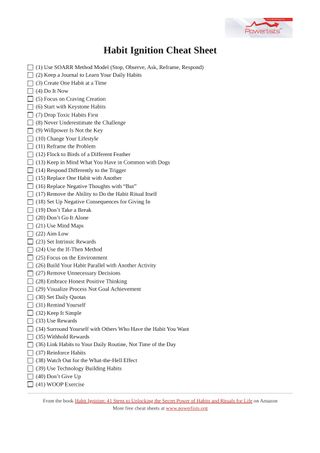
Get the free Habit Ignition cheat sheet
Frequently asked questions
How long does it take to form a habit?
In the best-known study, a new habit took 66 days on average to feel automatic, but individual times ran from 18 days to a projected 254. There is no fixed number.
Why does habit formation time vary so much?
More complex behaviors took longer, and exercise habits took about 1.5 times as long as eating or drinking habits. A glass of water with breakfast is easier to make automatic than a morning run.
What if I miss a day?
Do not quit. The researchers found that a single missed day had little impact on later automaticity gains, though many missed repetitions can lower it.
How do I start a habit that lasts?
Choose one small action, pick a cue you already have, do the same thing every time, track it, and plan for about 10 weeks.