This post contains affiliate links. If you buy through one, Urgesta AS may earn a commission at no extra cost to you. Read more.

To build a better habit, have someone else hand out the reward. When you are in charge of your own rewards, you will cheat. When a friend holds them and gives you one only after you did the habit, you can’t.
Below I cover why self-given rewards fail, what a trusted friend changes, and whether rewards or punishments work better. The ideas here come from my book Habit Ignition.
Why do we cheat on rewards we give ourselves?
Because nobody is checking. You promise yourself a treat for a week of workouts, you skip two days, and you have the treat anyway. The rule was yours, so you bend it.
Eric Ravenscraft made this point at Lifehacker in 2015, building on a post at Barking Up the Wrong Tree. That post says plainly: “Do not trust yourself to only whip those tasty candies about when you do your work.”
How does a friend fix the cheating?
A friend turns your plan into a rule you can’t quietly change. The same post suggests you “have a trusted friend dole out the rewards” and that the friend could throw out the candy or delete the audiobook if you miss your goal.
Two things matter here. The friend has to hold the reward, not just promise to ask how it went. And the friend can’t cheat for you, so pick someone who will say no.
Can you make the reward harder to cheat on without a friend?
Yes, by tying the treat to the habit so you can’t have one without the other. Katherine Milkman, Julia Minson and Kevin Volpp tested this in a study of gym visits (Management Science, 2014, via PubMed Central). They gave people tempting audiobooks, and one group could listen only at the gym. Afterward, 61% of participants paid to keep an iPod whose audiobooks worked only at the gym.
That is a commitment device: you set it up once, and it does the policing. A friend is another kind. My feedback loops post, Want to Create or Break Habits? Focus on Feedback Loops, shows how rewards fit into the habit loop.
Are rewards or punishments better?
For most people, positive rewards, though what works varies from person to person. I go into why in Habit Ignition. Try a reward first, and change it if it doesn’t pull you toward the habit.
If you want the bigger picture on habits first, start with What’s the Big Deal With Habits?. If you want someone watching your goals, make your progress public.
What did the gym study find?
The researchers called the idea temptation bundling: you pair something you want, such as a page-turner audiobook, with something you should do, such as exercise. People who could listen only at the gym went 51% more often than the control group. People who were only encouraged to save the audiobooks for the gym went 29% more often. The effect weakened over time, particularly after Thanksgiving (Milkman, Minson and Volpp, Management Science, 2014).
How do you pick someone to hold your rewards?
Choose a person who will say no to you and who will not feel awkward doing it. Tell them the rule in one sentence, for example: “I get the new episode on Friday only if I went to the gym three times.” Keep the reward small and something you really want, so that it is worth earning. If your reward habit is scrolling, see Does a Dopamine Detox Actually Work?. If it stops working after a few weeks, change the reward or the rule, as the study’s fading effect suggests.
How long should the reward system last?
Longer than a few days. In a study led by Phillippa Lally at University College London, people chose a simple daily health habit, such as eating fruit or going for a walk. On average it took 66 days for the habit to become as automatic as it would get, with wide variation between people and habits, and missing an occasional day did not seriously set it back (Gardner, Lally and Wardle, British Journal of General Practice, 2012). It was one study, so treat the number as a rough guide. The point for rewards is that you may need them for months, and one slip does not mean you failed. Tell your friend to carry on after a missed day.
How do you set it up in five minutes?
- Choose one habit and one clear target, for example three gym visits this week.
- Choose a small reward you really want, and give it to your friend to hold.
- Agree the rule in one sentence, and agree that the friend says no if you missed it.
- Check in at the end of the week, and either hand over the reward or don’t.
- After a few weeks, look at whether it still pulls you in. If not, change the reward.
The gym study suggests that rewards can lose their pull, so a review every few weeks is part of the plan, not a sign it is broken.
Want more?
Habit Ignition: 41 Steps to Unlocking the Secret Power of Habits and Rituals for Life Book

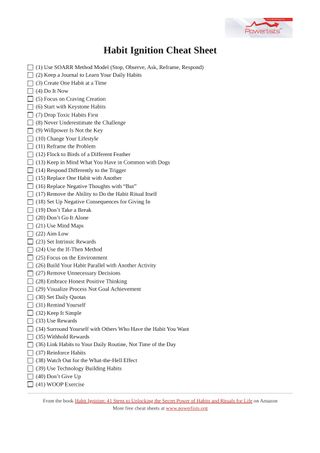
Get the free Habit Ignition cheat sheet
Photo by: Mohd Hafizuddin Husin
Frequently asked questions
Why do we cheat on rewards we give ourselves?
Because nobody is checking. The rule was yours, so you bend it, such as having the treat after skipping two workouts.
How does a friend fix the cheating?
A friend turns your plan into a rule you cannot quietly change. The friend has to hold the reward, and has to be someone who will say no.
Can you make a reward harder to cheat on without a friend?
Yes, by tying the treat to the habit. In a gym study, people who could listen to tempting audiobooks only at the gym went 51% more often than the control group in the first weeks.
Are rewards or punishments better?
For most people, positive rewards, though what works varies from person to person. Try a reward first, and change it if it does not pull you toward the habit.