Many resolutions fail because they are worded as something to stop, and because nothing is set up to carry them past January. The best study I found on this had 1,066 people follow their resolutions for a year. More of them kept going than I expected, and the way the goal was worded made a clear difference. Here is what it found, and what I would do with it.
What does the research say about New Year’s resolutions?
Martin Oscarsson and colleagues ran a large experiment on New Year’s resolutions and published it in PLOS ONE in December 2020. They recruited 1,066 members of the general public and split them at random into three groups: a control group, a group with some support and a group with extended support. The most common resolutions were about physical health, weight loss and eating habits.
At the one-year follow-up, 55% of the people who answered said they were successfully sustaining their resolution. So the idea that nearly everyone quits is not what this study found. It does not tell us about people who never signed up for a study, or who did not answer at the end (Oscarsson and others, 2020, PLOS ONE 15(12): e0234097).
Does the wording of the goal matter?
Yes, and it was the clearest finding. People with approach-oriented goals, where you aim to do something, succeeded 58.9% of the time. People with avoidance-oriented goals, where you aim to stop or avoid something, succeeded 47.1% of the time. The paper’s title says it directly: approach-oriented goals are more successful than avoidance-oriented goals.
“Eat vegetables with dinner” is an approach goal. “Stop eating junk” is an avoidance goal. Both aim at the same thing, but the first tells you what to do on a Tuesday evening and the second only tells you what not to do.
Does support help?
The study found that the group with some support was more successful than the other two groups. The paper reports estimated success rates of 62.3% for some support, 55.9% for no support and 52.5% for extended support. I would not read too much into why extended support did worse, because I did not find an explanation in the parts I read. The simple point is that a little structure helped.
How do you make a resolution stick?
These steps are my advice, built on the findings above. They are not from the study itself.
- Word it as something you do. Turn “stop snacking at night” into “have fruit and tea after dinner.”
- Make it small enough to do on a bad day. A resolution you can only keep when life is calm will not last.
- Pick one. If you have several, Too Many Goals and Doing None? How to Choose helps you decide.
- Set up a little support. Tell one person, or put a weekly check on your calendar. The study suggests some support beats none.
- Write down what counts as done. How to Set Goals You Actually Reach covers tracking and if-then plans, and Do SMART Goals Work? covers what makes a target specific.
What does the study not tell us?
Three limits. First, the people in the study chose to join a research project about resolutions, so they may care more than the average person who makes one. Second, the 55% is what people reported about themselves, and I did not see a check on it in the parts I read. Third, most resolutions in the study were about health and food, so I would be careful about applying the numbers to a resolution about money or work. My reading is that the study shows wording and support matter. It does not give you a guaranteed method.
When should you start?
You do not have to wait for January. A resolution is just a goal with a date on it, and any Monday works as well as the first of the year. If you plan to start in January, write the goal now, in December at the latest, and test the first week while the pressure is low.
What next?
If your resolution is really a habit change, How Long Does It Take to Form a Habit? shows how long to expect it to take.
If you want to start over without a full reset, see how to get your life together.
Want more?
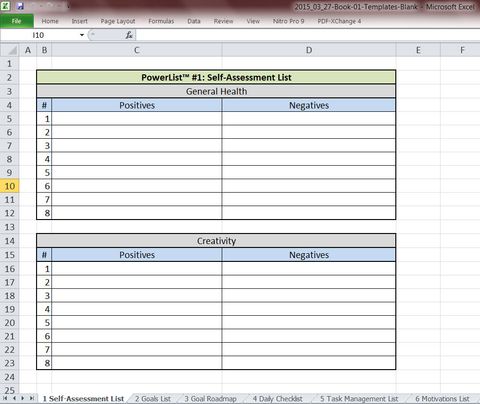
The book turns goals into lists you can tick off, and the free templates give you the sheets to start with.
Achieve Your Goals Now With PowerLists

Get the free PowerList Excel templates
Frequently asked questions
Do most New Year's resolutions fail?
Not in the study the post covers. At the one-year follow-up, 55% of the people who answered said they were successfully sustaining their resolution.
Does the way you word a resolution matter?
Yes. People with approach-oriented goals succeeded 58.9% of the time, against 47.1% for avoidance-oriented goals, where you aim to stop or avoid something.
Does support help you keep a resolution?
A little did. The group with some support was more successful than the other two groups, with an estimated success rate of 62.3%.
When should you start a resolution?
You do not have to wait for January. Any Monday works as well as the first of the year. If you plan to start in January, write the goal in December at the latest.