If you have ten goals and do none of them, the problem is probably not willpower. It may be that some of your goals pull against each other, so every choice feels like giving something up. One classic study found that people were less likely to act on goals that conflicted with their other goals, even though they thought about them more. Here is what it found, and a way to cut the list down.
What does the research say about goal conflict?
In 1988 Robert Emmons and Laura King published a study in the Journal of Personality and Social Psychology called “Conflict among personal strivings.” In two studies, 88 undergraduates each listed 15 personal strivings, then rated how much those strivings conflicted with each other and how ambivalent they felt about them. Higher conflict and ambivalence went with more negative affect, depression and psychosomatic complaints. Conflict also went with more health center visits and illnesses over the past year. The ratings were stable over a year and predicted later psychosomatic complaints.
A third study sampled the students’ thoughts and activities over three weeks. They were less likely to act on conflicted strivings, but they spent more time thinking about them (Emmons and King, 1988, J Pers Soc Psychol 54(6):1040-8).
That fits what a long goal list feels like: lots of thinking, little doing. Two limits matter. The study is from 1988, and it used students, so I read it as a clue and not as proof. It also measured conflict between goals, not the plain number of goals.
How do you choose between goals?
These steps are my advice, built on that finding. They are not from the study.
- Write every goal down. Getting them out of your head shows you how many there really are.
- Mark the ones that pull against each other. “Save more money” and “take a big trip this year” may be in conflict. “Walk daily” and “read more” may not be.
- Ask which one, if done, would make the others easier. Sleep, health and a basic money plan often do this. That is a judgment call, not a rule.
- Pick one for the next 90 days. The others are not cancelled. They go on a “later” list you will look at on a set date.
- Make it specific and track it. Do SMART Goals Work? and How to Set Goals You Actually Reach cover what the research says on both.
What if every goal feels important?
Then look for a smaller version of each and pick the one you can start this week. Starting counts for more than ranking. Once one goal is moving, the list feels less heavy, and you can bring in the next one.
If a goal is really a New Year’s resolution, Why Do New Year’s Resolutions Fail? covers wording it so it lasts.
What does a “later” list look like?
Keep it short and boring: one line per goal, and a date on your calendar when you will read it again. When that date comes, ask two questions. Is the current goal done, or at least a habit that runs without much effort? And does this goal still matter to me? If the answer to the second is no, delete it. A list you never look at is the same as a list in your head, so the date is the part that matters.
What if two goals do not conflict?
Then you may be able to run both, as long as each one is small. A daily walk and a weekly review of your money take little time and do not fight each other. The test I would use is simple: can you say exactly when and where you will do each one this week? If you cannot, one of them has to wait. That test is my own rule of thumb and not something from the research above.
What next?
If your plans are fine but you still don’t follow them, see why do I make plans and not follow them. Pick your one goal today and write it as something you do. Then set up a way to see your progress.
If your problem is a daily list that only grows, see how to manage a to-do list.
Want more?
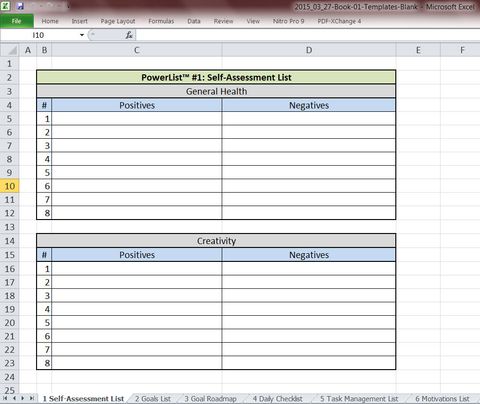
The book turns goals into lists you can tick off, and the free templates give you the sheets to start with.
Achieve Your Goals Now With PowerLists

Get the free PowerList Excel templates
Frequently asked questions
Why do I have ten goals and do none of them?
The problem may not be willpower. One 1988 study found that people were less likely to act on goals that conflicted with their other goals, even though they thought about them more.
How do I choose between goals?
Write every goal down, mark the ones that pull against each other, and ask which one would make the others easier. Then pick one for the next 90 days. These steps are my advice, not the study's.
What happens to the goals I do not pick?
They are not cancelled. They go on a later list that you read again on a set date.
Can I run two goals at once?
Possibly, if each one is small and they do not fight each other. My test is whether you can say exactly when and where you will do each one this week.