Partly. The research supports having a specific, hard goal and feedback on your progress, which are two things SMART goals ask for. It does not support the SMART acronym as a package, and one 2023 review says it has no scientific backing. Here is what the research says, and what I would do with it.
What does the goal-setting research say?
Edwin Locke and Gary Latham spent 35 years on this question and summarised it in American Psychologist in 2002. They report that, across meta-analyses, the harder the goal, the higher the effort and performance, up to the limit of a person’s ability or until commitment to the goal lapsed. Specific, difficult goals also “consistently led to higher performance than urging people to do their best,” with effect sizes in meta-analyses of .42 to .80. Their explanation is that “do your best” has no outside reference, so everyone defines it in their own way and a wide range of results feels acceptable (Locke and Latham, 2002, American Psychologist 57(9):705-717).
They also say goals plus feedback work better than goals alone, and that commitment matters: a goal you do not care about does little.
Where is the research mixed?
Three places.
Complex tasks. In the same paper, goal effects were smaller on complex tasks than on simple ones. For specific difficult goals against “do your best,” the effect size was .41 for the most complex tasks and .77 for the least complex. When you are still working out how to do something, a goal about learning can help more than a goal about results. The authors say few studies have tested both together.
The acronym. SMART usually stands for specific, measurable, achievable, relevant and time-bound, though some versions use realistic for the R. A 2023 narrative review in Health Psychology Review by Christian Swann and colleagues looked at SMART goals in physical activity. Its abstract says the acronym “is not based on scientific theory,” “is not consistent with empirical evidence” and “has a risk of potentially harmful effects” (PubMed 35094640). The abstract also lists other problems: the acronym does not consider what type of goal is set, is not applied consistently, lacks detailed guidance, has redundancy in its criteria and is not being used as originally intended. That is about one field, and it is a narrative review and not a test, so I would not stretch it to every goal.
“Achievable.” Locke and Latham found that hard goals did better than easy ones. If you read “achievable” as “safe,” that points the other way. Their finding applies up to the limit of your ability, and it assumes you are committed to the goal. My reading: pick a target you are not sure you will hit, but one you could hit with real effort.
So should you use SMART goals?
I would use the parts that have support and skip the label. These steps are my advice, built on the findings above.
- Make the goal specific, so you can tell whether you reached it. “Write 500 words a day” beats “write more.”
- Make it hard enough to stretch you, but not beyond what you can do. If you do not care about it, pick a different goal.
- Get feedback. Track it daily or weekly where you can see it.
- For something new and complicated, set a learning goal first, such as “find three ways to do this,” before you set a results goal.
- Add a plan for when and where you will act. How to Set Goals You Actually Reach covers the research on if-then plans and tracking.
A deadline is on the SMART list too. I did not find a source that tests deadlines on their own, so I leave that one as common sense.
If you have several goals and do none, Too Many Goals and Doing None? How to Choose helps you pick one.
What next?
If a goal keeps stalling, look at the habit behind it. How Long Does It Take to Form a Habit? shows what to expect while you change it. If the trouble is a long list of tasks, read My To-Do List Never Gets Shorter. How Do I Manage It?.
Want more?
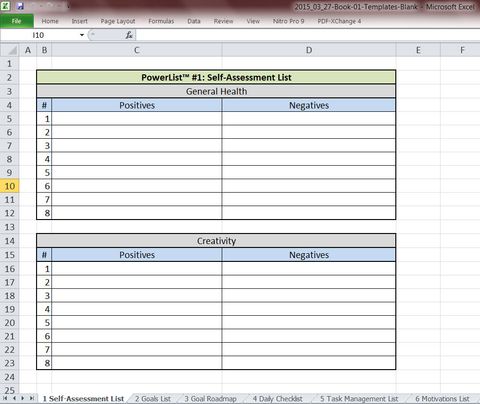
The book turns goals into lists you can tick off, and the free templates give you the sheets to start with.
Achieve Your Goals Now With PowerLists

Get the free PowerList Excel templates
Frequently asked questions
Do SMART goals work?
Partly. The research supports specific, hard goals and feedback, which SMART goals ask for. It does not support the SMART acronym as a package, and a 2023 review says it is not based on scientific theory.
What does the research say about hard goals?
Locke and Latham report that, across meta-analyses, the harder the goal, the higher the effort and performance, up to the limit of a person's ability or until commitment lapsed.
Is it better to set an easy goal you can reach?
The research points the other way. Hard goals did better than easy ones, as long as you are committed to the goal and it is within your ability.
What should I do instead of SMART goals?
Make the goal specific, make it hard enough to stretch you, get feedback, set a learning goal first for something new, and add a plan for when and where you will act.