A to-do list never gets shorter when it holds everything you might ever do and nothing about when you will do it. The fix is not a better app. It is fewer items in play, each one small, each one tied to a time and a place. Below: what the research says, where it runs out, and six steps to try. The steps are my advice, built on that research.
Why does my to-do list keep growing?
My reading: every idea, request and worry lands on the list, and nothing leaves it unless you act. A list like that is a pile. Looking at a pile of forty items is tiring, so many people freeze or open something easier instead.
What the research adds is about plans. Dr Pippa Lally of the University of Surrey says that if you make a clear plan of when and where you will do something, you are more likely to do it than if you have a vague intention (University of Surrey, 21-Jan-26). “Write the report” is a vague intention. “Tuesday at 9:00, at my desk, I open the report and write the first paragraph” is a plan.
Why does a long list make me freeze?
There is no research number for that freeze. What the habit research does show is what helps. In a paper on how habits form, simple actions became automatic faster than complex ones, and the authors suggest pairing a new action with a steady cue such as a time of day or an existing routine (British Journal of General Practice, Dec 2012). That is about habits, not lists, so treat it as a clue, not proof. The clue is: small, simple, and tied to a cue.
What if I miss a day?
The same paper found that missing an occasional day did not seriously derail habit formation. Progress picked up again after one miss. So a day when the list wins is not the end. Do the next planned item the next day.
What are six steps to manage a to-do list?
These are my advice. The studies above do not test them as a set.
- Empty your head once. Write down everything, in any order. You are not doing it yet, only storing it.
- Pick three items for today. Not ten. Three is a number you can finish, and finishing is what shrinks the list.
- Make each item a small action. “Sort the tax folder” becomes “Find the three tax letters and put them on the desk.” If it takes more than about 30 minutes, cut it down.
- Give each item a time and a place. “After lunch, at the kitchen table.” Put it in your calendar if that helps.
- Move the rest to a parking list. Anything not in today’s three goes there. Look at the parking list once a week, not every hour.
- Cross out, do not rewrite. At the end of the day, cross out what is done and move what is not to tomorrow, or let it go. Ask whether it still matters.
What should I do about tasks I keep avoiding?
My advice: look at why. If an item has sat there for weeks, it is usually too big, too vague, or not really yours. Shrink it, ask for help, or delete it. Deleting is allowed. A list is a tool, not a debt.
If the list is really a set of goals, such as “get fit” or “write a book”, a daily list is the wrong tool. Pick one goal first. Our post on too many goals helps with that, and why you make plans and then ignore them covers the gap between a list and a plan.
What next?
Tonight, take five minutes. Pick tomorrow’s three small items, give each a time and a place, and put the rest on the parking list. Tomorrow, do the first one before you open anything else.
Want more?
Achieve Your Goals Now With PowerLists

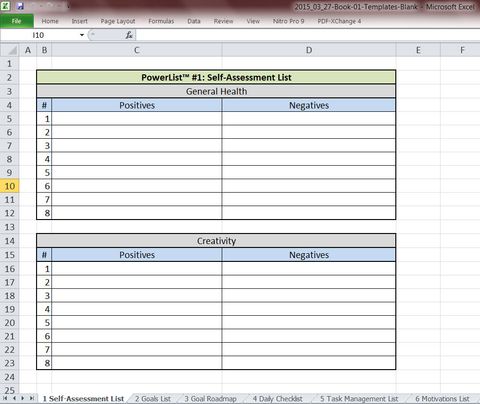
Get the free PowerList Excel templates
Frequently asked questions
Why does my to-do list keep growing?
Every idea, request and worry lands on the list, and nothing leaves it unless you act. A long list with no time or place for each item is a pile, not a plan.
How many items should be on my list for today?
My advice is three. It is a number you can finish, and finishing is what shrinks the list.
What if I miss a day?
The habit paper found that missing an occasional day did not seriously derail habit formation. Do the next planned item the next day.
What should I do about tasks I keep avoiding?
Look at why. An item that has sat there for weeks is usually too big, too vague or not really yours. Shrink it, ask for help or delete it.