Email overload is mostly a checking problem, not a volume problem. In a controlled study, people who checked three times a day were less stressed than the same people checking whenever they liked, and they got no less email. Below is what the study did, what it did not show, and how to copy it.
What does the research say about checking email less often?
Kostadin Kushlev and Elizabeth Dunn at the University of British Columbia gave 124 adults two different weeks. In one week they could check email as often as they wanted. In the other week they were told to check three times a day and keep the inbox closed the rest of the time (Kushlev and Dunn, Computers in Human Behavior, 2015).
The order of the weeks was randomized, so each person was compared with themselves. In the limited week people felt less daily stress and less tension during an important activity.
How often did people actually check?
In the limited week people reported checking 4.70 times a day on average. In the unlimited week it was 12.54 times. Before the study they said they normally checked 15.48 times on a workday, so the unlimited week looked like their normal habit.
Did they get less email when they checked less?
No. The authors counted emails received and answered in each week and found no significant difference in either. What changed was how often people looked.
That is the useful part. You cannot make other people send less to you, but you control how often you open the inbox.
What else changed?
People felt less distracted by their email in the limited week. The paper also reports that lower stress went along with higher well-being, mindfulness, self-rated productivity and sleep quality. The authors say that part is correlational, so it does not prove checking less causes those things. The direct causal finding is about stress.
The study has limits. The sample was 124 people with an average age of 30. It ran for one week per condition, and people answered questions about their own experience. It says nothing about jobs where a late reply costs money.
How do you check email less often?
The first three rules are what the study asked people to do in the limited week: fixed checks, a closed inbox and no alerts. The last two are my own advice.
- Turn off every email alert on your phone and computer, including the badge count.
- Pick fixed times. Three is what the study used. Two works for many people.
- Close the email program between those times, not just minimize it.
- Tell the people who need you fast to phone or message you, and say so in your signature.
- Answer in one pass. Delete, reply, or schedule it. Do not read a message and leave it for later.
If a rule feels too strict, start with one fewer check a day than you do now. You are looking for the point where nobody complains and you feel calmer.
What if your job needs fast replies?
Set up one channel for the urgent stuff. A phone number for the three people who matter beats checking an inbox of 40 messages every ten minutes to catch them.
If your boss expects an answer within the hour, show them the plan before you change anything. Two or three fixed checks, each followed by a full pass, can still be quick.
What next?
If your inbox is already full, how to clean out an inbox with thousands of unread emails shows how to clear it in bulk. To think about AI helpers, see is an AI email assistant worth it.
My tips for cutting the email that comes in are in 14 tips to get a grip on your email. If you keep checking out of habit, what’s the big deal with habits explains why.
Want more?
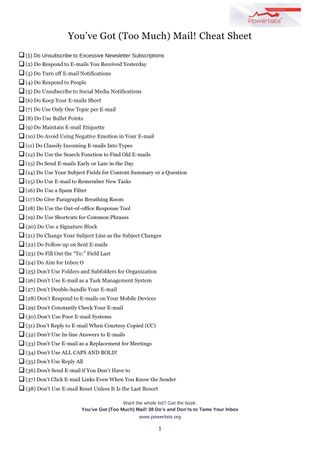
The book has 38 do’s and don’ts for taming your inbox, and the free cheat sheet gives you the short version.
You’ve Got (Too Much) Mail! 38 Do’s and Don’ts to Tame Your Inbox

Get the free You’ve Got Too Much Mail cheat sheet
Frequently asked questions
Does checking email less often reduce stress?
In a study of 124 adults, people who checked email three times a day felt less daily stress than in a week when they could check as often as they liked.
Do you get less email if you check less often?
No. The authors found no significant difference in the number of emails received or answered. What changed was how often people looked.
How often should I check email?
Pick fixed times. The study used three checks a day, and two works for many people. Close the email program between checks and turn off alerts.
What if my job needs fast replies?
Set up one channel for urgent messages, such as a phone number for the few people who matter, so you do not have to check an inbox every ten minutes.