You put off an email because of how it makes you feel, not because it takes long. The reply may feel awkward, unclear or like one more demand, so you do something easier first. Below: what the research says, where it runs out, and five steps to try. The steps are my advice, built on that research.
Why do I put off answering email?
Two researchers, Fuschia Sirois and Timothy Pychyl, argue that procrastination “has a great deal to do with short-term mood repair and emotion regulation.” The costs land on your future self (Social and Personality Psychology Compass, 1-Feb-13). Read that way, an unanswered email is a small bad feeling you are avoiding. Leaving it brings relief now and a heavier inbox later.
My own view is that email is a good place for this loop to start. A message can ask for a decision, deliver bad news or reopen a problem, and it sits in a list with every other message. Nothing forces you to deal with it. That is why how to stop procrastinating applies to your inbox too.
Why does a short email take half an hour?
My reading: the half hour is not spent writing. It is spent circling. You open the message, feel the pull to avoid it, check something else and come back. The reply itself would take two minutes.
One study with a small sample points the same way. A 2024 study of 68 people with high procrastination scores, who were tracked over 7 days, found that positive reappraisal lowered how unpleasant tasks felt more than an ineffective strategy did. That drop helped explain why they became more willing to act (Acta Psychologica Sinica, 25-Apr-24). In plain words, tasks got easier to start when they felt less unpleasant. The sample was small and it did not test email, so treat it as a clue.
What does research say about email itself?
Very little, and I would rather say so. A 2007 study of 133 students and marketing employees made a scale for using email as a break, which the authors call e-breaking. People who did this were more likely to procrastinate in their behaviour and spent more time on personal email (Baker and Phillips, Cyberpsychology & Behavior, Oct 2007). That is about using email as an escape from other work. It does not explain why some replies sit for days.
So the mood-repair idea fits, but nobody has shown it is the whole story for email. Other causes are likely: unclear asks, too much volume, or a reply that needs real thought.
What are five steps to answer the email you are avoiding?
These are my advice. The research above does not test them as a set.
- Name what makes it hard. Is it awkward, unclear, long or just boring? One word is enough. Once named, it is easier to deal with.
- Write one sentence. Not the full reply. Open the message and write the first line. Often you keep going.
- Send a holding reply. If you need time, say so: “Thanks, I will answer properly by Friday.” That ends the open loop.
- Give it a set time. Pick a slot in your day for replies, instead of fitting them in whenever. My post on 14 tips to get a grip on your email covers the Yesterbox idea of answering yesterday’s mail.
- Delete or decline what you will never answer. Not every email needs a reply. If you will not do it, say a short no or let it go.
If you are starting from a very full inbox, how to clean out an inbox with thousands of unread emails comes first. Clear the pile, then work through the few that need you.
When is it more than email?
If putting things off comes with low mood that does not lift for weeks, constant tiredness or no interest in things you used to enjoy, talk to a doctor. Email tricks will not fix that.
Want more?
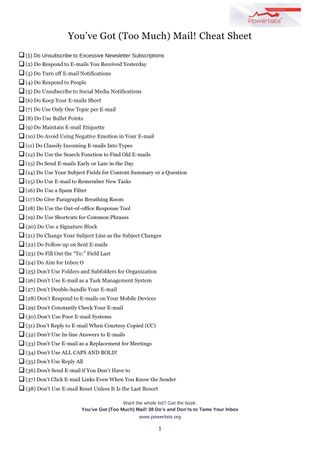
The book has 38 do’s and don’ts for taming your inbox, and the free cheat sheet gives you the short version.
You’ve Got (Too Much) Mail! 38 Do’s and Don’ts to Tame Your Inbox

Get the free You’ve Got Too Much Mail cheat sheet
Frequently asked questions
Why do I put off answering email?
Researchers link putting things off to short-term mood repair. A reply that feels awkward, unclear or tiring makes you do something easier, and you feel better for a while.
Why does a short email take me half an hour?
My reading is that the time goes on avoiding the reply, not writing it. The writing is small, but the feeling around it is not. This is my view, not a research finding.
Is there research on delayed email replies?
Very little. A 2007 study of 133 people found that those who used email as a break were more likely to procrastinate in their behaviour, but it did not test why replies are delayed.
How do I get replies done?
Shrink the first step to one sentence, name what makes the email hard, set a time to answer, and send a short holding reply if you need longer. These steps are my advice.